Datacap Systems Inc. is entering the softPOS arena with its new SureTap point-of-sale application, with which merchants can use their own devices. Any new transactions made with the application will contribute to the other bit of Monday’s POS news. The total value of global POS transactions are forecasted to reach $41.1 trillion in five years, says Juniper Research.
Chalfont, Pa.-based Datacap says SureTap enables merchants to use their own compatible devices, such as smart phones, as the hardware component in a transaction without having to buy or lease a dedicated POS terminal. Datacap says SureTap supports contactless transactions on NFC-enabled Android devices and relies on its payment gateway for connectivity to multiple processors.
Datacap says SureTap distinguishes itself in that the transaction data is not isolated just to the app. The data connects to Datacap’s platform to give merchants a unified view of the transaction regardless of which payment method was used.
SureTap uses the same API code used for traditional card-present terminals to ease the integration into the merchant’s POS system, Datacap says. Other features include consolidated reporting with other payment methods. Also, independent software vendors marketing SureTap control the pricing and retain customer ownership, Datacap says.
“By connecting softPOS support with credit, debit, ACH, eCommerce, and gift transactions via a unified commerce platform, SureTap helps our partners enable the full range of use-cases for their merchants; from in-store and mobile checkout to online and recurring payments, all via a single, seamless payments engine,” Justin Zeigler, Datacap vice president of product, says in a statement.
In related news, the value of global POS transactions are forecasted by Juniper Research to reach $41.1 trillion in 2031, a potential 37% increase from $30.1 trillion in 2026.
A German court has ordered FIFA to overhaul its 2026 World Cup ticketing operations, ruling that the organization’s sales platforms employed misleading pricing, obscured key information, and utilized aggressive, unlawful sales tactics.
The preliminary injunction, issued by the Frankfurt am Main Regional Court on July 13, prohibits FIFA from continuing these practices for consumers in Germany. The order follows a challenge by the secondary ticket marketplace Ticombo, which argued that FIFA was violating standard consumer-protection and transparency laws that govern the broader ticketing industry.
The ruling puts FIFA in an awkward position. Major sports bodies have long pushed to centralize ticket resale within their own closed systems, often characterizing independent marketplaces as the source of industry abuses. The Frankfurt decision serves as a blunt reminder that the same transparency standards used to police third-party platforms apply equally to event organizers managing their own primary and secondary markets.
“This decision does not create new, special laws,” said Marçal Gutiérrez Balle, Ticombo’s head of legal. “It simply applies existing European requirements, such as the Digital Services Act, to a dominant organizer. It is a powerful reminder that everyone in this industry, including major event organizers, must abide by the same rules of fair competition.”
A request for comment on the injunction sent to FIFA’s media relations staff did not receive a reply as of Wednesday afternoon.
Targeting Deceptive Purchase Flows
The court took issue with specific features on both FIFA’s “Last-Minute Sales” platform and its official resale marketplace.
On the primary sales site, the court barred FIFA from advertising “from” prices when no tickets were actually available at that rate. Ticombo cited an example where tickets were marketed as starting at $1,745, only for the price to jump to $8,995 once a user entered the purchase flow. The court also ruled that FIFA cannot force buyers to commit to a seat before disclosing the final total cost, a practice it found violated German unfair-competition standards.
Furthermore, the court labeled the platform’s high-pressure design as an “aggressive commercial practice.” This included a rigid, six-minute countdown that, if expired, forced users back to a waiting queue—losing all progress and requiring a complete restart, including a new CAPTCHA. FIFA’s “Book the best seat” feature further exacerbated the issue by defaulting to the most expensive option without showing individual seat prices, a combination the court deemed unfairly coercive.
“This injunction clearly establishes that FIFA’s manipulative ‘dark patterns’ (such as bait-and-switch pricing and predatory countdowns) are unlawful,” Balle said.
Mandatory Disclosure for Commercial Sellers
The ruling also mandates that FIFA disclose the identity and address of any commercial sellers on its official resale marketplace before a transaction is finalized.
While official platforms are often presented as safe, fan-to-fan alternatives, the legal obligations change when professional traders are involved. The court found that under the EU’s Digital Services Act, FIFA is required to provide the identity of these commercial sellers—a transparency measure that official channels had previously bypassed.
Ticombo initiated the challenge after discovering that remaining ticket inventory from national football associations was being funneled into FIFA’s resale platform without proper identification of the sellers. The court agreed with Ticombo’s assessment, officially recognizing the two entities as competitors under German law.
Because this is a preliminary injunction issued without an oral hearing—due to the time-sensitive nature of the tournament—it is not a final judgment. The order is also geographically limited to FIFA’s operations involving German consumers. FIFA has the right to challenge the ruling, though it did not submit comments when initially prompted by the court.
Ticombo stated it does not intend to pursue monetary damages, as the tournament concludes this week. However, the ruling serves as a vital signal: while organizers may control the ticket inventory and the sales channels, they remain subject to the same consumer-protection laws as everyone else.
“We hope this will change FIFA’s ticketing practices moving forward,” Balle said.
A newly released standard for QR code payments could make it easier for consumers and merchants to use instant payments, says the Accredited Standards Committee X9 Inc. X9 is a nonprofit organization that develops and maintains national and international standards for the financial-services industry.
The new standard, officially called X9.150, Merchant-Presented QR Codes for Secure Payment, will allow every bank or merchant app with a QR code reader or generator to be used for secure payments with anyone, anywhere in the United States, X9 says. It could be especially helpful in making account-to-account payments. Work on the X9.150 standard began in 2024. X9 says approximately 45 million instant payments are made each month in the United States, compared with eight billion in Brazil.
There has been no standard for secure merchant-generated QR codes in the U.S. prior to this new standard, the committee says. That has meant little interoperability among businesses and financial networks, likely stymieing use. The X9.150 standard provides a common framework for financial institutions and payment providers to determine the most appropriate payment method, the committee says.
This type of QR code is distinct from ones that navigate a user to a URL, X9 says. “Unlike URL QR codes, payment QR codes must be scanned from within an authenticated mobile app (e.g., that of a bank, credit union or merchant wallet) where the user has logged in and the application itself is recognized as an authorized client. This ensures that both the payer and the application making the request are trusted before the protected payment payload can be accessed,” X9 says in a statement.
The new X9.150 standard defines the structure, content, and security requirements for merchant-presented QR codes for initiating push payments. A major benefit of the standard is that the same QR codecan initiate payment across different account-based payment methods, which means merchants do not need to support separate payment protocols for each network.
“Businesses want to get paid faster while making it as simple as possible for consumers to pay. This standard creates a foundation for delivering both. As adoption grows, businesses will be able to offer a consistent payment experience while financial institutions retain the flexibility to choose the payment networks that best serve their customers,” says Sarah Hoisington, chair of the X9.150 Work Group and general manager, North America at Matera, a specialist in QR code payment tech, in a statement.
Visa Inc. has taken steps to make smart phones a more readily available way for merchants, especially micro-size ones, to digitally accept payments with updates to Visa Pay, Visa Accept, and Visa Direct.
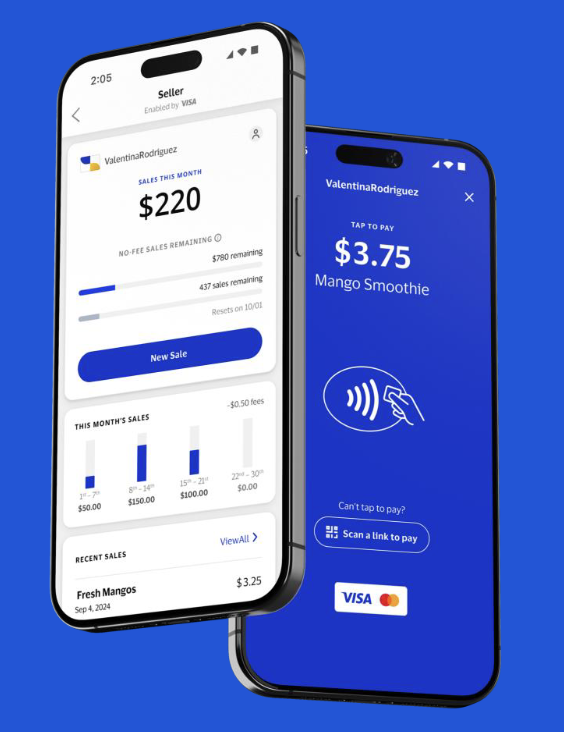
With Visa Accept, announced in April 2025, Visa makes it easier for these small sellers to get paid to their eligible Visa debit cards from any NFC-capable smart phone. Visa Pay connects any participating wallet to any Visa-accepting merchant, local or international, in-store or online. Visa Direct is the brand’s near real-time payment service to cards. Now, businesses can send payouts, such as compensation for contractors and staff, and consumer refunds, using their phones.
Visa Accept is an entry-level acceptance service for micro-sellers and very small businesses that might not be ready for a traditional merchant, Rubail Birwadker, Visa’s global head of growth, tells Digital Transactions News via email. “Sellers enroll through a participating issuing bank’s digital banking app using an eligible Visa Debit or reloadable prepaid credential. As sellers grow and reach market-specific thresholds, they can be offered an upgrade path to a full merchant solution with more advanced features,” Birwadker says. Sellers can receive funds in minutes, he says.
Sellers need a smart phone that can support their bank’s app and payment method, such as tap-to-pay, QR code, or payment link. “Specific device requirements may vary by market, issuer and implementation, but the core idea is to let sellers accept payments using the phone they already rely on, without adding separate point-of-sale hardware,” he says. Visa Accept merchants can use their bank’s app to accept payments without extra hardware or a dedicated payment-acceptance app. Visa says the same buyer protections, security practices, and dispute protections apply to Visa Accept transactions.
Visa Accept transactions are sent over Visa’s network and use Visa Direct to move funds to the seller’s account, he says. “Sellers are subject to market-specific transaction or sales thresholds; once those thresholds are reached, they can be prompted to upgrade to a fuller merchant solution. The limits are designed to keep the experience appropriate for entry-level sellers while creating a path for business growth,” Birwadker says.
Visa Accept is available in more than 25 countries and live with banks in Sri Lanka, Guatemala, and Vietnam, with others in Kenya and Ghana expected to launch in coming weeks.
Merchants wrestle with fraud every day, lamenting how much is lost in each bad transaction. LexisNexis Risk Solutions, as it’s done for a number of years, has quantified the actual cost beyond the item’s value.
In 2026, the total cost of every $1 in fraud is $5.13 in the United States and $5.23 in Canada for retailers and e-commerce merchants. That is up from $4.61and $4.52, respectively, from 2025. This marks the first time the $5 threshold has been crossed in both markets, the company says.
What’s changed is that new attack vectors are having an impact. LexisNexis Risk Solutions says fraud risk is increasingly distributed in digital and physical channels, payment types, and customer touchpoints.
“Online and mobile channels now account for most fraud costs, representing up to 83% for e-commerce merchants. Common fraud types include chargeback fraud, lost or stolen merchandise and fraudulent returns, reflecting the breadth of threats facing merchants today,” the Atlanta-based company says.
For U.S. retailers, the top three fraud loss types were chargeback fraud at 12%, and lost or stolen merchandise and fraudulent requests for a return or refund, each at 11%. It was similar in Canada with chargeback fraud at 14%, lost or stolen merchandise, 14%, and scams and impersonation fraud at 13%.
For U.S. e-commerce operators, chargeback fraud accounted for 12% as did first-party fraud, followed by lost or stolen merchandise, 11%. In Canada, fraudulent requests for a return or refund accounted for 16% of fraud losses, followed by scams and impersonation fraud at 16%, and chargeback fraud at 14%.
Payment cards, in both countries, accounted for large shares of fraud losses by payment type.
Card transactions, at 26%, garnered the biggest share of fraud costs by payment method for U.S. retailers, and rose to 31% for U.S. e-commercemerchants. In Canada, card transactions were cited in 43% of fraud losses for retailers, though digital wallets, at 26%, outpaced cards at 20% for Canadian e-commerce merchants.
Additionally, the cost of fraud has increased substantially over time. It was at $2.40 in 2016 and now has more than doubled.
Live Nation and Ticketmaster logo over an image of a concert crowd
The Department of Justice has released the fine print of its proposed Live Nation–Ticketmaster settlement, detailing a no-breakup agreement that critics say leaves Ticketmaster at the center of the ticketing ecosystem despite years of government allegations of monopolistic conduct.
The proposed final judgment, filed Friday in federal court in Manhattan and included at the end of the article, formalizes the framework the DOJ reached earlier this year with Live Nation Entertainment and Ticketmaster. The agreement is backed by the DOJ and six settling states: Arkansas, Iowa, Mississippi, Nebraska, Oklahoma and South Dakota.
The settlement is not yet final. It must go through the Tunney Act process — including public notice and a 60-day comment period — before U.S. District Judge Arun Subramanian determines whether it serves the public interest.
On Monday, U.S. District Judge Arun Subramanian entered the parties’ stipulation and order, allowing the DOJ settlement to proceed through the Tunney Act review process and putting key provisions into effect while that review is pending. The order does not constitute final approval; the court must still determine whether the proposed judgment is in the public interest after the required notice and comment period.
The settlement has become a flashpoint because the DOJ’s original case was centered on an effort to break up Live Nation and Ticketmaster. Instead, the proposal now before the court leaves the company intact and relies on conduct remedies, limited interoperability, contract changes, venue-specific provisions and monitoring.
There has also been widespread criticism of the way the deal was reached, with the settlement agreed to between senior Trump administration officials and Live Nation’s leadership, without the awareness of the DOJ’s trial attorneys. The deal, which came after a lengthy and well-documented flattery and influence campaign among well-connected Trump insiders, has been characterized as both incompete and corrupt by many in both live entertainment and political circles/
Consumer and competition advocates who reviewed the comprehensive deal as outlined in the filing said the details confirm their concern that the agreement does not meaningfully address the underlying structure of Live Nation’s market power.
“The behavioral remedy in the DOJ’s proposed judgment in the Live Nation-Ticketmaster monopolization case reveals the lengths that the Trump DOJ went to avoid breaking up the company,” Diana Moss, vice president and director of competition policy at the Progressive Policy Institute, told TicketNews. “The judgment extends the saga of failed past behavioral remedies with an even bigger, more complex, and harder to enforce set of gerry-rigged ‘access’ conditions.”
Moss said Live Nation and Ticketmaster would “keep their monopoly in ticketing,” leaving room to “find workarounds to the conditions so that it can continue to ice out competition.”
John Breyault, vice president at the National Consumers League, said the settlement fails to address what consumer advocates view as the core problem: the company’s vertical integration across ticketing, promotion, venue operations and artist relationships.
“The DOJ’s proposed settlement fails to address the root causes of Live Nation’s monopoly — the vertical integration that forecloses serious competition in nearly every facet of the live event ecosystem,” Breyault told TicketNews. “Weak provisions that purport to open Ticketmaster’s backend to third-party marketplaces and requiring divestiture of relatively minor amphitheater contracts will not create competition or break the anti-competitive ‘flywheel’ that DOJ rightfully flagged in its original complaint against the company.”
Live Nation has defended the agreement as a major reform package. When the framework was announced in March, the company said it had “consistently maintained that the DOJ’s allegations were without merit” and that the settlement would resolve remaining DOJ claims “without any admission of wrongdoing.”
CEO Michael Rapino said at the time that the settlement marked “a major step in improving the concert experience for artists and fans throughout the United States.” He added that Live Nation’s amphitheaters would be opened to all promoters, who could decide how to distribute up to 50% of tickets, while Ticketmaster service fees at those venues would be capped at 15%.
“By giving artists greater flexibility in choosing their promotional partners and ticketing strategy while also keeping the cost of a concert more affordable for fans, we are putting more power where it should be — with artists and fans,” Rapino said.
The proposed judgment makes clear, however, that Ticketmaster would remain embedded in the core infrastructure used by many major venues. The agreement would require Ticketmaster to build an “open distribution and ticket authentication system” allowing qualifying third-party primary ticketing providers to sell tickets allocated by venues that continue using its back-end system.
The distinction is central. The settlement does not separate Ticketmaster’s marketplace from its ticketing infrastructure or require venues to leave the platform. Instead, it allows competitors to operate within a system where Ticketmaster continues to control inventory management, barcodes, validation, entry and related data flows.
Under the proposal, Ticketmaster would have 275 days after entry of a final judgment to make the system fully operational and available as a standalone product.
Eligible providers would be able to use their own marketplace technology to list tickets, process payments, handle refunds, support customer accounts and render Ticketmaster-issued barcodes or tokens. Ticketmaster would also be prohibited from forcing consumers to pay additional fees or take materially burdensome steps — such as using a Ticketmaster account — when purchasing through a third-party primary provider.
However, Ticketmaster would still be allowed to charge third-party providers fees tied to use of its infrastructure, subject to oversight by a court-appointed monitor. In effect, the settlement opens access but does not remove Ticketmaster from the economics of the transaction.
“Even if the proposed opening of Ticketmaster’s backend took effect, competitors would still find themselves operating within an ecosystem controlled by their largest rival,” Breyault said. “As long as Live Nation’s vertical integration remains intact, the underlying incentives to stifle competition will persist.”
The filing also clarifies who qualifies to participate. To be deemed an “Eligible Primary Ticketing Services Provider,” companies that operate both primary and resale marketplaces must meet conditions including prohibiting speculative listings, complying with artist or content-owner resale restrictions, requiring seller identification and ensuring listings include verified ticket details.
The definition could prove significant for platforms such as StubHub and SeatGeek, which operate across primary and secondary markets. It also underscores a broader limitation: access to the system depends on complying with rules that preserve substantial control for artists, venues and content owners over resale activity.
If Ticketmaster disputes a provider’s eligibility, the issue would be decided by the monitor, with the DOJ able to seek a court ruling.
Moss said enforcing those conditions could prove especially difficult in a digital ticketing environment.
“In an almost fully digital, technology-driven ticketing market, the judgment’s interoperability conditions on Ticketmaster’s ‘back-end’ services will be virtually impossible to detect and enforce,” she said. “With no disrespect to monitors and antitrust compliance officers, non-compliance with the technical aspects of the remedy would require a SWAT team of full-time digital investigators.”
The treatment of venue contracts is narrower than a broad rollback of exclusivity. Existing agreements would lose automatic renewal provisions, and venues would be allowed to use another eligible ticketing provider for one event per year.
For contracts with at least four years remaining, venues could allocate up to 20% of ticket inventory to third-party providers, though Ticketmaster could adjust financial terms tied to exclusivity. Disputes would be resolved by the monitor.
Future contracts would be limited but not barred from exclusivity. Fully exclusive deals would be capped at four years, while partially exclusive agreements — leaving at least 20% of tickets open — could last longer under certain conditions. Contracts would not be allowed to include auto-renewals or penalize competitive bidding processes.
The structure gives venues more flexibility, but still allows Ticketmaster to maintain long-term relationships and remain the dominant platform.
“The judgment’s main feature is a complex web of conditions governing partially non-exclusive venue ticketing contracts,” Moss said. “This murky landscape will only serve to intimidate venues into taking the least risky path and signing up again with Live Nation-Ticketmaster.”
At Live Nation-owned, operated or controlled amphitheaters, the rules are more direct but still limited. Promoters and artists would be able to distribute up to 50% of tickets through third-party providers, while Ticketmaster service fees on its own sales would be capped at 15% of face value.
While that is a meaningful constraint, it does not apply broadly across Ticketmaster’s inventory and is limited to those amphitheaters.
The agreement also clarifies earlier descriptions of “divestiture.” Rather than requiring full asset sales, the remedy focuses on relinquishing booking, promotion or control-related rights at 13 specified venues, including sites in Alabama, Arkansas, Michigan, New York, Texas and Wisconsin.
Venue operators would be able to terminate or modify existing arrangements and conduct new ticketing RFPs. Live Nation would be barred from reasserting control or entering preferred booking agreements at those sites.
The settlement also addresses Oak View Group. Within 30 days of court approval, Live Nation and Ticketmaster would have to terminate a 2022 incentive agreement with OVG and disclose related financial arrangements to affected venues, which would then be allowed to rebid ticketing contracts without penalty.
Anti-retaliation provisions prohibit Live Nation and Ticketmaster from penalizing venues for working with competing ticketing providers or promoters, though carveouts allow for independent artist decisions and ordinary business conduct.
The proposal includes compliance measures such as monitoring, reporting requirements and financial penalties for violations, but it remains a conduct-based remedy layered onto years of prior restrictions following the companies’ 2010 merger.
Moss said those safeguards fall short without structural change.
“‘Firewalled’ employees with access to competitively sensitive data can easily be moved around the company to avoid restrictions,” she said.
The agreement would require advance notice of certain future acquisitions but does not broadly prohibit them, apart from limits tied to reacquiring divestiture-related assets.
“The judgment fails to prohibit any further acquisitions,” Moss said. “Instead, it imposes standard notification requirements, leaving the door open to rebuilding the monopoly.”
The financial component is narrower than early descriptions suggested. The filing outlines approximately $18.56 million in payments to the six settling states, separate from a previously announced $280 million fund tied to broader state claims.
Those broader claims remain unresolved. A coalition of non-settling states, led by New York Attorney General Letitia James, proceeded to trial and secured a jury verdict finding Live Nation and Ticketmaster liable under federal and state antitrust laws. They are now pursuing remedies that include breaking up the company.
The contrast is stark. The DOJ’s original lawsuit sought structural separation. The settlement instead relies on managed access to Ticketmaster’s systems, limits some exclusivity, modifies venue arrangements and imposes oversight — while leaving the company intact.
For competitors, the deal could open limited pathways into major venues. For artists and promoters, it could expand flexibility at Live Nation-controlled amphitheaters. For venues, it offers modest carveouts and opportunities to test alternatives.
But the central feature remains unchanged: Ticketmaster continues to serve as the infrastructure underlying much of the system. Access is conditional, alternatives are partial, and exclusivity persists.
Moss said the court should reject the proposal.
“In a Tunney Act review, the court could find that the proposed judgment fails the public interest test,” she said. “Only a breakup remedy clearly addresses the violation and restores competition.”
The court will now decide whether the settlement meets that standard. For fans, artists, venues and competitors, the broader question is whether a system that keeps Ticketmaster at its center can meaningfully restrain the power the government set out to challenge.
With large payments companies beginning to incorporate cryptocurrency and alternative payment methods into their processing flows, the opportunity for sales agents and their acquirers to sell another payment-acceptance method is growing. That’s the takeaway from a panel discussion this week at the Southeast Acquirers Association conference in Miami Beach, Fla.
“For decades, the payments industry has always been primarily focused on traditional credit and debit acceptance,” Mark Standfield, chief strategy officer at AltoPay, a Miami-based payments provider, said. “Globally, we’re now seeing … alternative payment methods. This includes real-time payments, digital wallets, stablecoins, and cryptocurrency.”
Both of the largest card brands, Mastercard Inc. and Visa Inc., have made crypto forays. Mastercard has added settlement windows and alone runs more than 100 card programs globally that link to stablecoins. It moved deeper into the digital currency with its agreement in March to acquire BVNK, a London-based stablecoin platform, for $1.8 billion. Visa this week said it is working on tokenized deposits that could enable banks to convert traditional deposits into digital money, Digital Transactions News reported Thursday.
Though consumer use of cryptocurrency and alternative payment methods may not be anywhere near the volume of credit and debit card payment activity, it is viewed as a burgeoning aspect.
“Between the international travelers coming here who want to use their native payment methods, and the sheer volume of wealth Americans hold in crypto, it has become a necessity,” panelist Chris Benabu, chief growth officer and cofounder of Suede, told attendees. “Merchants need to accept these rails because that is where the money is. People have money in checking accounts, but they also have money in crypto and APMs. It’s just another essential tool that should exist in a merchant’s ecosystem.”
Technical issues that once plagued the integration of new payment methods have diminished with the use of application programming interface coding that lets disparate software platforms exchange data securely. To accept a cryptocurrency at an in-store checkout, a merchant need only make a QR code available for the crypto consumers to scan.
Acquirers and sales agents can help educate merchants about this option and others, says Jay Sykes, founder and chief executive of Bead Pay Inc., a Dover, Del.-based alternative-payments provider.
“Crypto is not new,” Sykes said. “Bitcoin arrived on the scene in 2009, primarily as a peer-to-peer cash system born during a period of very low confidence in traditional financial systems. Why was adoption historically slow? It came down to a lack of understanding. Merchants won’t accept what they don’t understand.”
Cryptocurrency use, however, has grown in the ensuing 17 years, he said. Between 50 million and 60 million U.S. consumers own crypto, Sykes said. “To put that into perspective, about 70 million Americans hold an American Express card, and around 50 million have a Discover card. These users aren’t coming down the line—they are already here.”
Any participant in a new payment method has to have an incentive to use it. For consumers, that typically is ease of use and faster payments. For merchants, it means the potential to get new customers and reduce payment-processing fees. For acquirers, it means more revenue.
Sykes said many alternative payment methods, including cryptocurrency, often have lower processing fees than traditional credit and debit payments. “Traditional merchant acquisition focused almost exclusively on credit and debit cards,” he said. “Introducing these alternative rails serves as a legitimate customer-acquisition tool for the merchant. You aren’t just lowering their cost per transaction, you are introducing entirely new transactions from customers who otherwise wouldn’t have shopped there.”
In most instances, the pricing models and agent residuals for these payment products are designed to match those of the traditional card-processing infrastructure, said Gustavo Jimenez, chief executive and cofounder of North Miami, Fla.-based Blokko.
“You should view this as an incremental, high-value capability—much like adding a proprietary gift card program or a loyalty solution that directly drives top-line revenue for the business,” Jimenez said. “Because the reporting and financial models are identical to what merchants are used to, it removes operational fear. It makes it easy to explain, easy to digest, and highly lucrative for the agent.”
Payments executives who may be hoping that a court ruling Tuesday will put an end to years of bitter wrangling over card-acceptance costs are likely to be disappointed, experts tell Digital Transactions News.
“This does not end the argument. It just stifles it,” says Cliff Gray, principal at Gray Consulting Ventures, a Chicago-based payments advisory. Adds Aaron McPherson, principal at AFM Consulting LLC: “While certainly significant, the settlement by no means ends the argument.”
These opinions come as a federal court in Brooklyn on Tuesday ruled that a settlement reached between banks and merchants in a hotly contested, 21-year-old class-action case is “fair, reasonable, and adequate.” The court’s approval, however, is preliminary, leaving merchants hopeful and banks and processors wary. The settlement projects merchants would save $38 billion in acceptance costs over five years.
Merchants have for decades fought interchange, the cost they pay to payments acquirers and processors on each card transaction they accept. That battle has left scars, observers say. “While the settlement grants merchants modest economic relief and additional tools to pressure the networks, and allows Mastercard and Visa to eliminate a massive, existential legal risk, nobody should expect the mega-retailers to go quietly,” says Eric Grover, principal at the consultancy Intrepid Ventures.
Indeed, merchants disappointed by the outcome of the case are looking for the court to deny final approval of the settlement. “The vast majority of merchants oppose this proposed settlement,” says Doug Kantor, general counsel at the National Association of Convenience Stores, in a statement. “We expect many more objections to be filed that will present the court with clear evidence of the profound problems with this settlement that would make the already broken credit card market even worse.”
“We are hopeful that the judge will refuse to grant final approval, and that merchants will have their day in court,” Kantor adds.
Some observers argue the merchants may have a case, given how long the dispute has already lingered in and out of court. “Ten basis points [on interchange] is not much of a concession, given interchange pricing, especially given all the advances in the … years since this suit was initiated,” says Gray.
That could lead to further litigation, extending the case at least another two years, some experts say. “I would assume if Judge Cogan grants final approval, which is more likely than not, that major merchants will appeal it, potentially pushing the ultimate resolution out into 2028,” notes Grover. Brian Cogan is the presiding judge in the case.
For now, some observers are calculating the possible consequences if the current resolution stands. One scenario, argues McPherson, is that consumers could “face discrimination based on their choice of card, and with it the loss of their rewards, plus ever expanding- surcharges, all for the speculative benefit of lower prices in the future.”
Meanwhile, he points out, “Federal legislation restricting credit card interchange is still under consideration.”
A perpetual bane of payments, chargebacks create issues for merchants and their payment providers. Now, Findustry AI Inc. hopes its new artificial intelligence-enabled Chargeback Agent product will help ease the work of complying with card-brand dispute processes.
Led by Jonathan Razi, who sold CardX, a surcharging-services provider, to Stax in 2021, Findustry AI is pitching Chargeback Agent as intelligent enough to automatically resolve most chargebacks.
“The pain of chargebacks is going up,” Razi tells Digital Transactions News. “There’s more card-not-present volume than before,” he says in explaining why this is an opportune time to combine artificial intelligence with the dispute-resolution process. Issuing banks also are making it easier for cardholders to initiate a dispute, and the card networks, specifically Mastercard Inc. and Visa Inc., have updated programs for handling disputes, with an emphasis on the acquiring role in monitoring them.
A screenshot from Findustry AI displays what a merchant sees in the Chargeback Agent portal.
Findustry AI’s services are available via payment facilitators and acquirers, Razi says. Kurv is a client, as is payfac Allpaid.
On the merchant side, large merchants often have teams of employees managing disputes, but smaller ones do not, Razi says. Chargeback Agent is for merchants of all sizes, he says, but may benefit smaller ones the most. “Often they are not even responding to disputes by deadline,” Razi says. Small businesses are drawn in multiple operational directions daily, and payments is just one piece of their oversight duties.
“The benefits are [that Chargeback Agent] has the intelligence to match the evidence to the card-network rules,” he says. Chargeback Agent, the first of other expected AI-enabled services from Findustry AI, is built on so-called foundation models of AI engines and then tweaked for the payments space. “You have to build all the payment workflow and the proprietary data that makes it even more accurate and high performing,” Razi says.
Because AI services are known to have varying capabilities, Findustry AI accesses multiple ones as warranted. “In a workflow we make multiple calls to multiple models,” Razi says. Each model is good at different aspects and Findustry AI has mapped out these differences.
Once a merchant is alerted to a new dispute, staff enter the Findustry AI portal, which can be built into an acquirer’s portal, and view it. Chargeback Agent collects the evidence from the merchant, and, because the AI service has been trained on the card-network dispute rules, it knows the specific evidence to collect for each reason code, eliminating the manual-review step. Findustry AI uses APIs, a programming code to enable disparate platforms to exchange data, to supply transaction data to Chargeback Agent.
From there, the agent drafts a response letter using text that has been proven to produce favorable outcomes. Merchants can review, edit, or approve the response with one click. Submitting the response is the third step. Findustry AI says every human-made edit to all the responses is fed back into the AI engine so it can learn.
Merchants can customize how much autonomy they want to give Chargeback Agent, Razi says. For example, a merchant can designate Chargeback Agent to handle all elements of disputes of less than $300, but require a human review for those of more value.
Imagine waving a wand and making something appear in your hands. While it’s not magic, the Cash App Wand could make that happen.
Announced Thursday, Cash App Wand is the first in a series of Cash App Tags, which are NFC-enabled, physical payment accessories that let consumers pay without having to use a phone or card. Cash App is part of Block Inc.
Unlike many of the wands seen in recent viral videos, the Cash App Wand does not hold a contactless card. Instead, a small NFC-enabled chip is housed in the wand, which is only 4.29 inches long and 1.71 inches at its widest part. And this device is only usable with a Cash App account.
The Cash App Wand is the first in a planned series of devices using a Cash App Tag.
Available now for $25, the wand is the first of multiple styles Cash App intends to offer. Limited runs of other Cash App Tag-enabled devices will be available in coming weeks, Cash App says, with general availability later this summer.
In addition to having a Cash App account, users also must have an active Cash App Card. The tag is activated by opening Cash App on a mobile phone and linking the tag to their Cash App Card. One the tag is activated, a contactless transaction made with the wand takes less than a second, Cash App says.
Cash App says idea for the wand form factor got its footing in the autumn of 2025, before what is assumed to be the earliest viral video on Jan. 21 of Becca Bloom on TikTok using a homemade wand to shop. Bloom laminated a credit card between two sheets of yellow paper in the shape of stars, People.com reports.
“If anything, it’s validation: customers independently arrived at the same idea we did, which tells you something real about what Gen Z finds whimsical and worth carrying,” a Cash App spokesperson tells Digital Transactions News. A recent Cash App survey of Gen Z consumers—those born between 1997 and 2012—found that 38% of them purchase collectibles, accessories, or limited-edition items at least monthly.
“We see a unique opportunity here to make payments visible and social for the first time,” Thomas Templeton, Block’s hardware lead, says in a statement. “Early testers have told us that they’ve loved carrying the Wand and showing it off at checkout, so we believe there’s a real appetite for this among our customers.”
The Cash App Tag will make it easier for users to pay with Cash App without having to access the wallet they carry or on their smart phone. “The card form factor is limited since it’s often buried in a wallet and invisible. The same goes for digital wallets. Cash App Tags are designed to be seen,” the spokesperson says.
In addition to security measures covering activation of the Cash App Wand, lost or stolen ones can be reported in the app and deactivated instantly. Users also can choose to lock the Cash App Tag in the app, which also is available for the Cash App Card, and unlock it in the app when they want to use it. Cash App Tag’s link to the Cash App Card means transaction alerts, customer service, fraud monitoring, and Zero Fraud Liability services are included. Cash App Tags are accepted wherever Visa contactless transactions are available.